

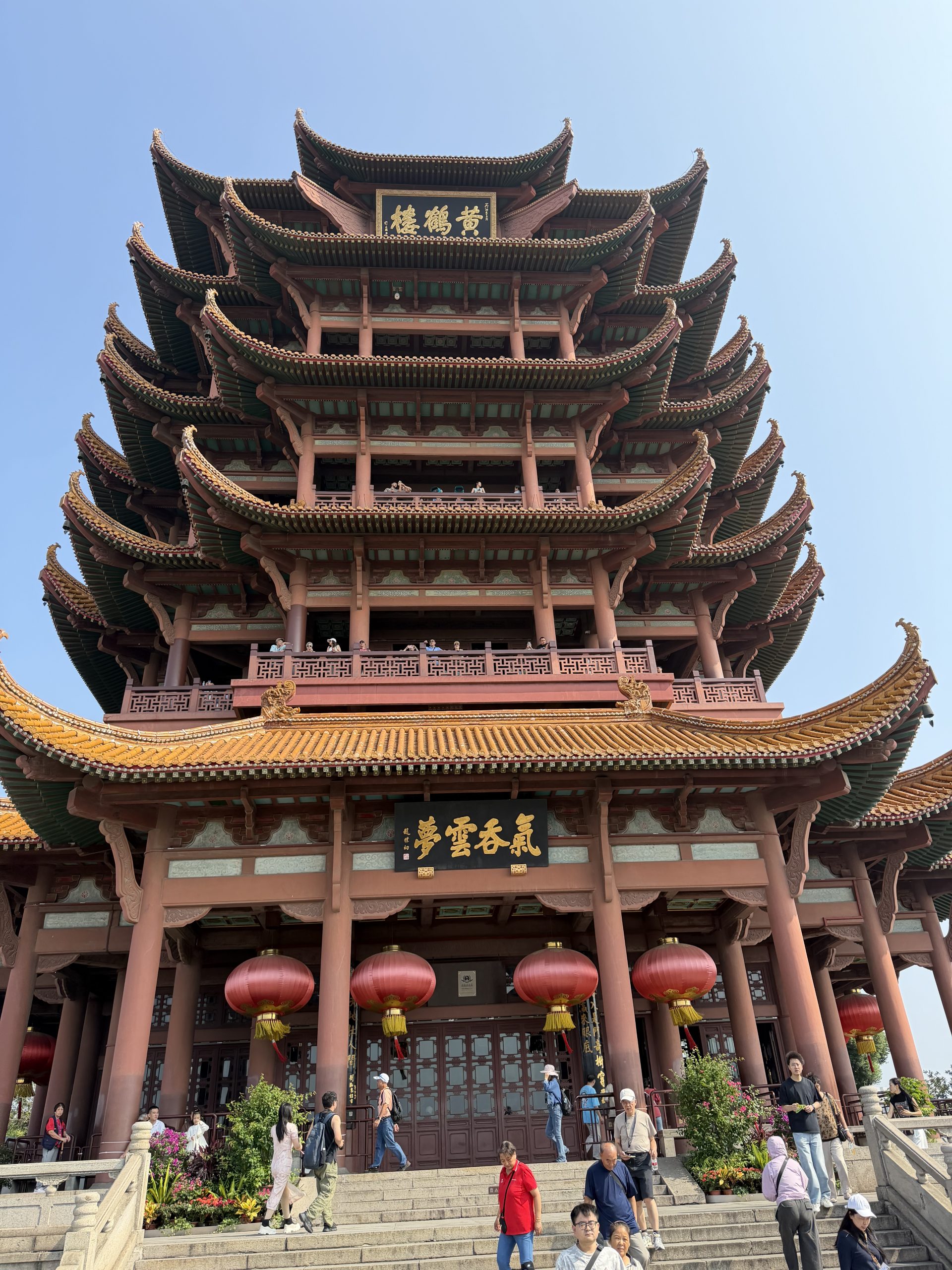
On the sixth day of our Century Legend Yangtze River cruise, Rosa and I disembarked in Wuhan, a city rich in both ancient legend and modern energy. Our main destination was the famous Yellow Crane Tower — one of the Four Great Towers of China — a name that has echoed through Chinese poetry and history for nearly 1,700 years.
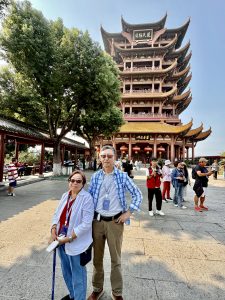
The original tower was first built during the Three Kingdoms period, and since then, it has been destroyed twelve times — by wars, by fires, by the passage of history itself — and rebuilt ten times. The last structure at the original site was erected in 1868 but sadly perished in 1884. A later version appeared in 1907 near the same location, and the magnificent tower we see today was rebuilt in 1981, standing proudly once more on Snake Hill, overlooking the great Yangtze River.
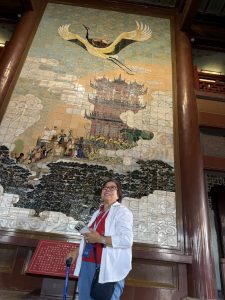
In Chinese, the word “crane” (鹤) symbolizes xian — immortals — and the Yellow Crane Tower has long been associated with legends of transcendence. One ancient tale tells of a scholar who rode away on a yellow crane, ascending into the heavens and leaving behind only the tower to mark his departure. Perhaps that is why, standing before it, we felt as though the air itself carried a touch of eternity.
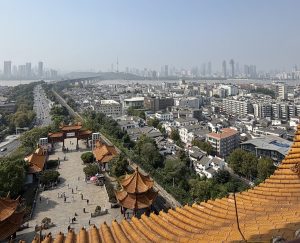
We took the elevator to the top and stepped out to a breathtaking view — the vast Yangtze River winding through the heart of Wuhan, bridges arching gracefully over the water, and a sea of modern buildings glimmering in the autumn sun. From this height, we could feel the deep pulse of a city where history and modern life flow together like the river itself.

Our next stop was the Hubei Provincial Museum, home to some of China’s greatest archaeological treasures. Among its countless exhibits, two masterpieces captured our hearts.
The first was the Sword of Goujian, a blade unearthed from a tomb over 2,000 years old. Despite the passage of time, the sword remains astonishingly bright and sharp, its intricate patterns still gleaming faintly with ancient mystery. Holding the legend of the Yue King Goujian, it stands as a symbol of perseverance and resilience.
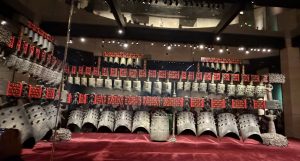
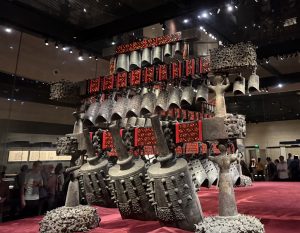
The second was the Bianzhong of Marquis Yi of Zeng, a set of 65 bronze bells cast 2,500 years ago. These bells are not just relics — they are music. Each bell can produce two distinct tones, and together they form a complete scale that can still be played today. As we watched the demonstration and listened to the resonant notes echoing through the hall, it felt as if the voice of ancient China had come alive again.
That evening, as our ship departed from Wuhan, the lights of the city shimmered across the water like countless stars. Rosa and I stood on deck in silence, still hearing the lingering notes of the bronze bells in our hearts — echoes from a civilization both eternal and ever-renewing.