

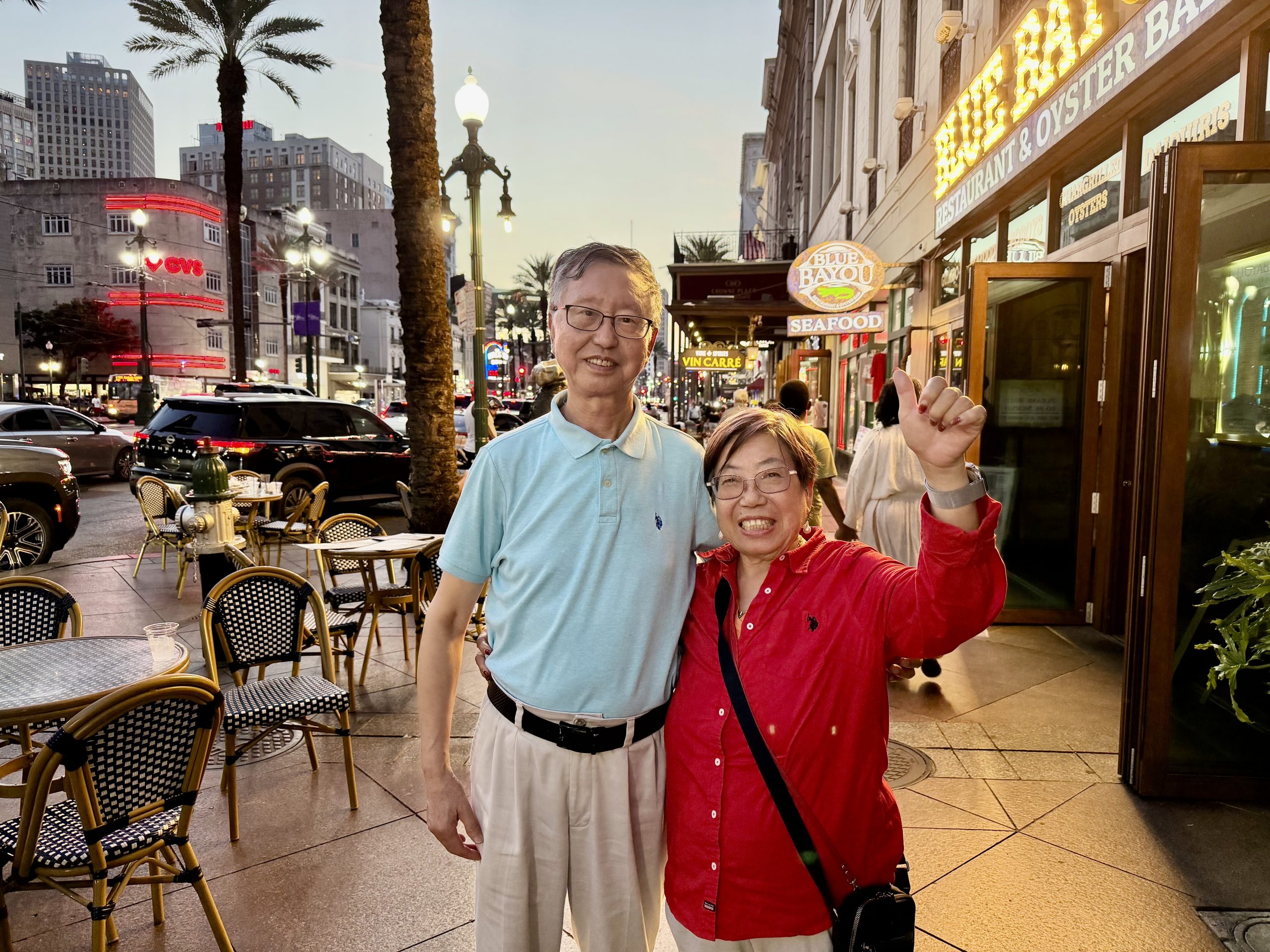
From July 18 to 23, Rosa and I spent six memorable days exploring New Orleans, one of America’s most distinctive and culturally rich cities. For me, the trip was also a journey back in time. I had first visited New Orleans about 40 years ago, but this was Rosa’s first encounter with the city. Although much has changed over four decades, the unique charm that drew me here years ago remains very much alive.
The main attraction for both of us was the legendary French Quarter. To fully experience its atmosphere, we booked a hotel right in the heart of the district, allowing us to explore its narrow streets, historic buildings, and lively squares entirely on foot. Joining us during our visit was my World Journal colleague and longtime friend, Jenny Chen, whose company made the trip even more enjoyable.
The French Quarter is the oldest neighborhood in New Orleans, founded by the French in 1718. Ironically, despite its name, many of the elegant balconies and colorful buildings that define the Quarter today were built during the Spanish colonial period after two devastating fires in 1788 and 1794 destroyed much of the original French settlement. During the 19th century, the neighborhood faced another existential threat. As New Orleans expanded upriver, many civic leaders considered demolishing much of the aging French Quarter to make way for modern development. Fortunately, preservationists recognized its historical and architectural significance, and their efforts ultimately saved one of America’s greatest cultural treasures. Today, the French Quarter stands as a National Historic Landmark and attracts millions of visitors from around the world each year.
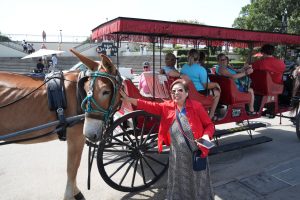
Walking through the French Quarter was a feast for the senses. Street performers entertained crowds, horse-drawn carriages rolled over the old streets, and music seemed to drift from every direction. From the afternoon until well past midnight, jazz bands performed in restaurants, bars, and on street corners, creating an atmosphere unlike any other city.
New Orleans is widely regarded as the birthplace of jazz. The musical style emerged around the turn of the 20th century, blending African rhythms, blues, ragtime, brass band traditions, church music, and European musical influences. Musicians in neighborhoods such as Storyville experimented with improvisation and collective performance, giving birth to a new form of music that would eventually spread across the globe. Legendary artists such as Louis Armstrong began their careers in New Orleans, and today jazz remains deeply woven into the city’s identity.
Before arriving, we had heard that Frenchmen Street was the place to experience authentic live jazz. One evening we made a special trip there, expecting to find the street filled with music. To our surprise, however, only a handful of businesses were open, and there was no live music being played outdoors. It was a disappointing contrast to what we had anticipated. Ironically, the French Quarter itself offered far more music and energy than we had expected, with performances seemingly around every corner throughout the day and evening.

One of the highlights of our visit was attending a performance at Preservation Hall. We each paid $50 for admission to the intimate concert, and it proved to be worth every dollar. Preservation Hall is more than just a music venue; it is an institution dedicated to preserving and promoting traditional New Orleans jazz. Since opening in 1961, it has introduced generations of musicians and audiences to the city’s original jazz traditions. The performance took place in a small, simple room without elaborate lighting or special effects. Instead, the focus was entirely on the musicians and their extraordinary talent. The passion, improvisation, and interaction among the performers created an unforgettable musical experience that captured the very spirit of New Orleans.
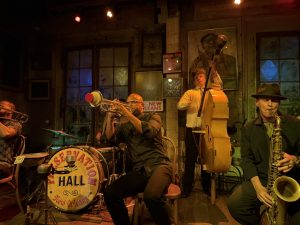
Authentic Jazz, no speakers.
Our exploration extended beyond the city streets. We joined a swamp boat tour through the wetlands surrounding New Orleans, gliding quietly through moss-covered cypress trees and peaceful bayous. Along the way, we spotted several alligators basking in the sun, as well as turtles, birds, and other wildlife native to Louisiana’s unique ecosystem. The tranquil beauty of the swamp offered a striking contrast to the lively energy of the French Quarter.

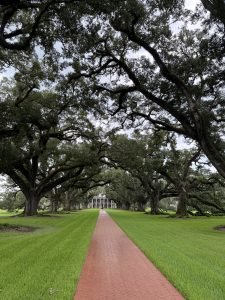
Another memorable excursion took us to Oak Alley Plantation, one of the most photographed historic estates in the American South. Located about an hour west of New Orleans along the Mississippi River, the plantation is named for the spectacular avenue of 28 giant live oak trees that form a majestic canopy leading from the mansion to the river. Many of these trees are more than 300 years old, predating the construction of the plantation house itself. Walking beneath their sprawling branches was like stepping into another era, and it is easy to understand why Oak Alley has become one of Louisiana’s most recognizable landmarks.
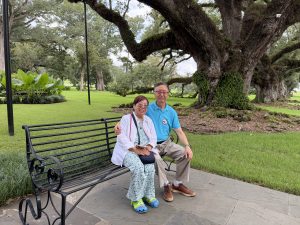
The elegant Greek Revival mansion, completed in 1839, reflects the immense wealth generated by the sugar industry during the antebellum period. Yet behind its beauty lies a far more sobering history. Like many Southern plantations, Oak Alley depended on the labor of enslaved African Americans. Hundreds of men, women, and children worked under brutal conditions to plant, harvest, and process sugarcane, one of the most labor-intensive crops of the 19th century. Their lives were marked by long hours, harsh punishment, and the denial of even the most basic freedoms. Today, the plantation has made a concerted effort to tell not only the story of its owners but also that of the enslaved people whose labor built and sustained the estate. Restored slave cabins and historical exhibits provide visitors with a deeper understanding of this painful chapter in American history.
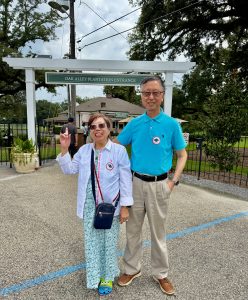
Our visit to Oak Alley served as a powerful reminder that the grandeur of the Old South came at an enormous human cost. The contrast between the magnificent mansion and the modest slave quarters was striking, underscoring the profound inequalities that shaped the plantation economy before the Civil War. It was both an educational and deeply moving experience.
Many visitors associate Oak Alley Plantation with Gone with the Wind, Margaret Mitchell’s classic novel and the 1939 Academy Award-winning film. Although the story was actually set in Georgia and neither the novel nor the movie was based on Oak Alley, the plantation’s breathtaking oak-lined approach has become an iconic symbol of the romanticized Old South. Because of its timeless beauty, Oak Alley has appeared in numerous films, television productions, and commercials over the decades. Standing beneath the centuries-old oaks, it was easy to see why many people imagine this is the setting that inspired Gone with the Wind. Whether or not the legend is true, the scenery is undeniably unforgettable.

Another highlight was our visit to the National WWII Museum. Many visitors may wonder why one of the world’s premier World War II museums is located in New Orleans rather than Washington, D.C. The answer lies in history. The museum was founded here because New Orleans-based industrialist Andrew Higgins designed and built the famous Higgins boats, the landing craft that played a crucial role in the Allied amphibious invasions, including the D-Day landings in Normandy. General Dwight D. Eisenhower later remarked that Andrew Higgins was “the man who won the war for us.”

The museum contains an extraordinary collection of artifacts, personal stories, aircraft, and military equipment. Among the exhibits that particularly caught my attention was the Flying Tigers. Officially known as the American Volunteer Group, the Flying Tigers were American pilots who volunteered to fight alongside China before the United States officially entered World War II. Flying their distinctive shark-faced P-40 fighter aircraft, they defended Chinese cities and supply routes against Japanese forces and became symbols of courage and international cooperation during China’s War of Resistance against Japanese Aggression. Seeing this exhibit was especially meaningful because it highlighted an important chapter of shared Chinese and American history.

Our visit came during one of the hottest periods of the year. Daytime temperatures were extremely high, and the heat and humidity often made sightseeing physically demanding. Even short walks required frequent breaks and plenty of water. Yet the weather did little to diminish our enjoyment. The music, history, architecture, cuisine, and warm hospitality of New Orleans more than compensated for the summer heat.
As we left New Orleans after six unforgettable days, I reflected on how differently I experienced the city compared with my visit four decades earlier. Back then, I was simply a tourist discovering a famous American city. This time, I appreciated its history, its resilience, and its extraordinary cultural legacy on a much deeper level. For Rosa, it was a wonderful first visit. For me, it was a meaningful reunion with a city that has preserved its soul despite the passage of time.
New Orleans is far more than a destination. It is a city where history, music, and culture come together in ways found nowhere else. Despite the sweltering summer weather, the memories we made—from wandering the enchanting French Quarter and listening to unforgettable jazz at Preservation Hall to cruising through Louisiana’s swamps and exploring the remarkable World War II Museum—will stay with us for many years to come.